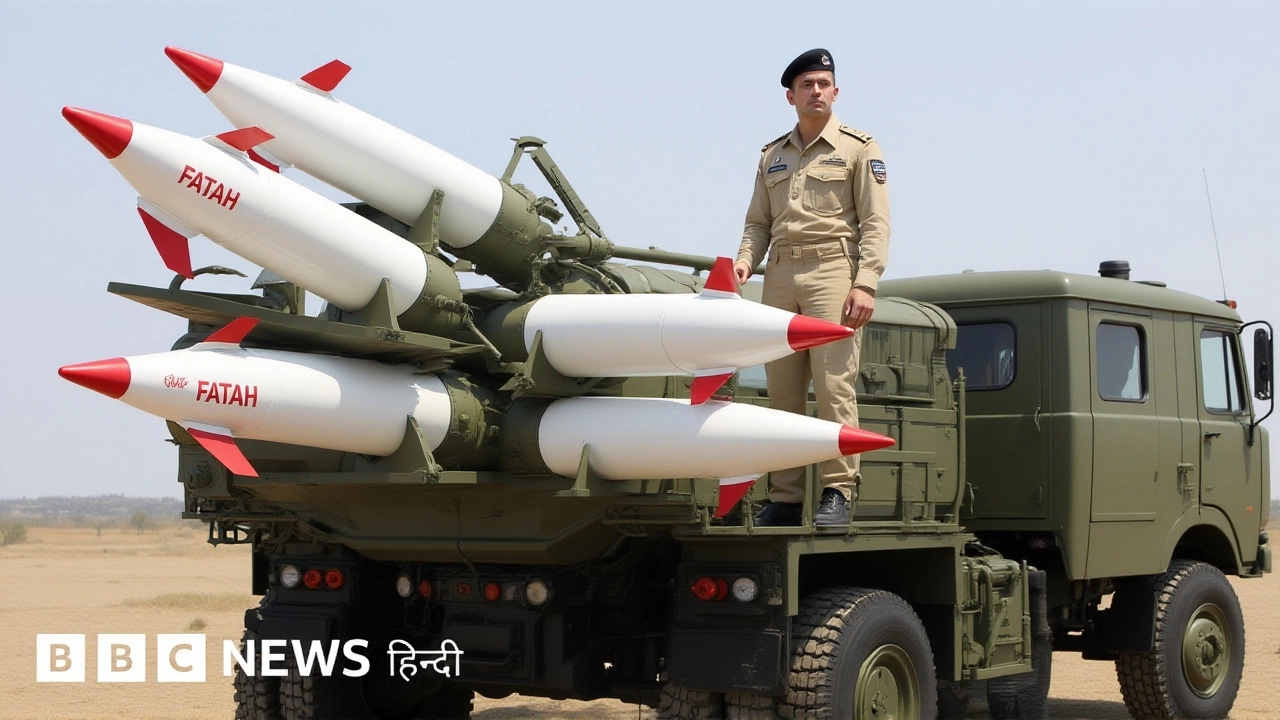
When Pakistan Army Rocket Force Command rolled out its new supersonic cruise missile on Thursday, May 7, the geopolitical temperature in South Asia spiked. The weapon, named Fatah-3, isn't just another addition to their arsenal—it’s a direct, calculated response to India's long-standing advantage with the BrahMos missile system.
The unveiling happened on the first anniversary of last year’s four-day conflict between the two nuclear-armed neighbors. Timing it this way sends a clear message: Islamabad is ready to play hardball without crossing the nuclear threshold. Here’s the thing—this missile changes the conventional balance of power significantly.
The Specs That Matter
Let’s look at what makes the Fatah-3 tick. Reports indicate it can fly at speeds between Mach 2.5 and Mach 4—that’s roughly 3,704 to 4,939 kilometers per hour. For context, that’s three to four times the speed of sound. It carries a warhead weighing between 240 and 400 kilograms and has a strike range estimated at 290 to 450 kilometers.
But wait, there’s more. Unlike earlier ballistic missiles in the Fatah family, this one is a cruise missile. It’s road-mobile, mounted on twin-canister Transporter-Erector-Launchers (TELs). This means each truck can fire two missiles simultaneously, making it harder for enemy air defenses to track and intercept them all. The system is designed for both land-attack and anti-ship missions, using terrain-hugging and sea-skimming flight profiles to stay under the radar.
China’s Role in the Equation
Turns out, Pakistan didn’t build this from scratch. Defense analysts widely believe the Fatah-3 is a localized derivative of China’s HD-1 supersonic cruise missile. Developed by Guangdong Hongda, the HD-1 shares similar characteristics. By leveraging Chinese technology, Pakistan has drastically cut down its development time.
This deepens the strategic partnership between Islamabad and Beijing. It also highlights how China is acting as a frontline broker for conventional counterforce capabilities, extending its influence from Kashmir to the Persian Gulf. If this trend continues, we might see these systems exported to Gulf partners like Saudi Arabia, further complicating the regional security architecture.

The BrahMos Challenge
For years, India held the upper hand with BrahMos, a joint venture between India and Russia. The original BrahMos had a range of about 290–300 km and carried a 300 kg warhead. The Fatah-3’s specs mirror these closely. However, India is already working on an extended-range variant of BrahMos with a reach of 700–800 kilometers.
So, does Fatah-3 neutralize India’s advantage? Not entirely, but it narrows the gap considerably. It gives Pakistan a viable conventional option to target strategic infrastructure and naval assets without resorting to tactical nuclear weapons. This shifts the doctrine towards survivable, distributed precision-strike warfare.

Strategic Implications for South Asia
The introduction of Fatah-3 signals a doctrinal shift for Pakistan. They are moving away from relying solely on nuclear deterrence for high-intensity conflicts. Instead, they are building a robust conventional deterrent that can operate below the nuclear threshold. This blurs the line between conventional war and nuclear escalation, creating a precarious stability.
Experts warn that this could lead to an arms race. If Pakistan integrates Fatah-3 into its pre-conventional conflict doctrine, India will likely accelerate its own missile programs. The result? A region armed to the teeth with increasingly sophisticated, fast-moving weapons that leave defenders with mere seconds to react.
Frequently Asked Questions
What is the primary purpose of the Fatah-3 missile?
The Fatah-3 is designed as a supersonic cruise missile capable of both land-attack and anti-ship missions. Its main goal is to provide Pakistan with a precise, conventional strike capability against strategic targets like military bases and naval vessels, reducing reliance on nuclear options.
How does Fatah-3 compare to India's BrahMos?
Fatah-3 mirrors the original BrahMos in speed (Mach 3-4) and range (approx. 300-450 km). However, India is developing an extended-range BrahMos variant reaching up to 800 km, which currently gives New Delhi a longer reach, though Fatah-3 closes the gap for shorter-range engagements.
Is the Fatah-3 made in Pakistan or imported?
While Pakistan produces the final assembly locally, the technology is derived from China’s HD-1 supersonic cruise missile. This collaboration allows Pakistan to utilize advanced Chinese engineering while maintaining domestic manufacturing control.
Why was the missile unveiled on May 7?
The date marks the first anniversary of the four-day military conflict between India and Pakistan. Unveiling the missile on this day serves as a symbolic statement of Pakistan’s enhanced conventional military readiness and deterrence capabilities.